
mas del taperal
ARTIST RESDIDENCY
spain


the residency
The house is the result of a long quest undertaken by the painter ClaudePanier and his partner, IsabelleParisod, in search of a place conducive to creation.
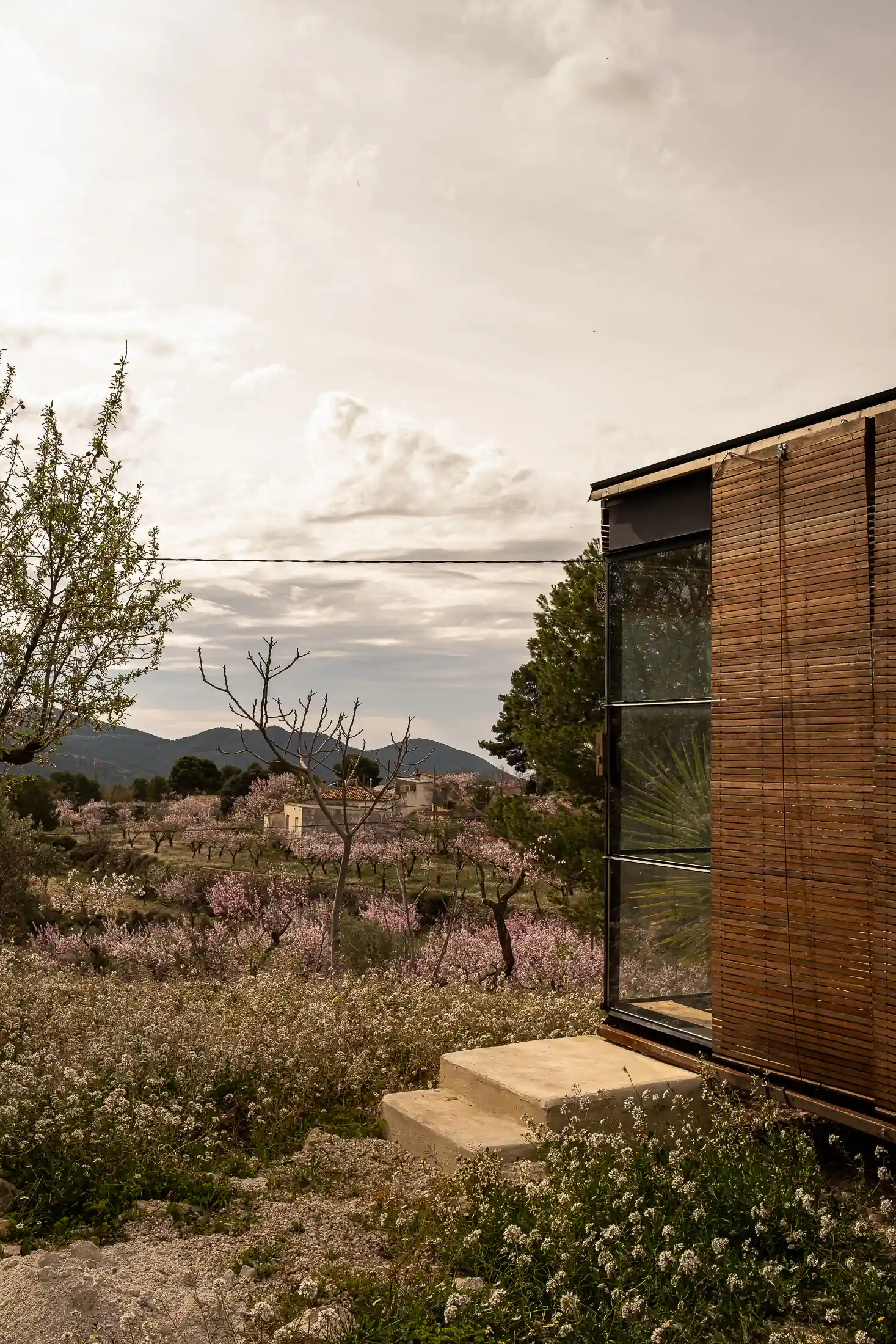
Nestled in a fertile valley in the Alicante region, it offers a commanding view of centuries‑old almond and olive trees on terraced slopes. From its inception, ClaudePanier designed it as a space of tranquility and light, conducive to artistic work. After his passing, IsabelleParisod continued the project by expanding and renovating the house to provide artists with an inspiring setting in which to develop their projects.
Today, she opens these spaces to creation and exchange, thus perpetuating the original vision of a refuge dedicated to art and expression.
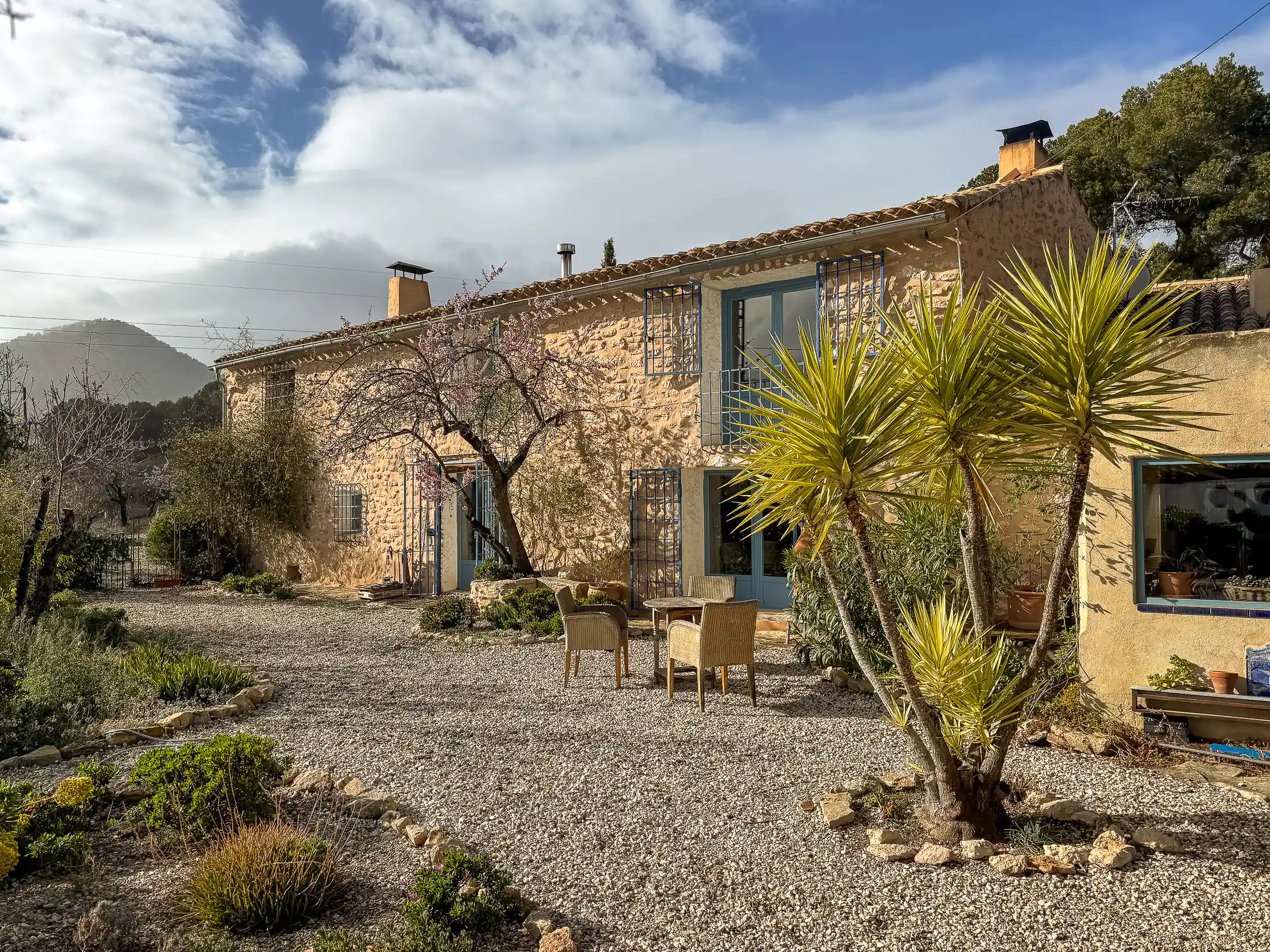

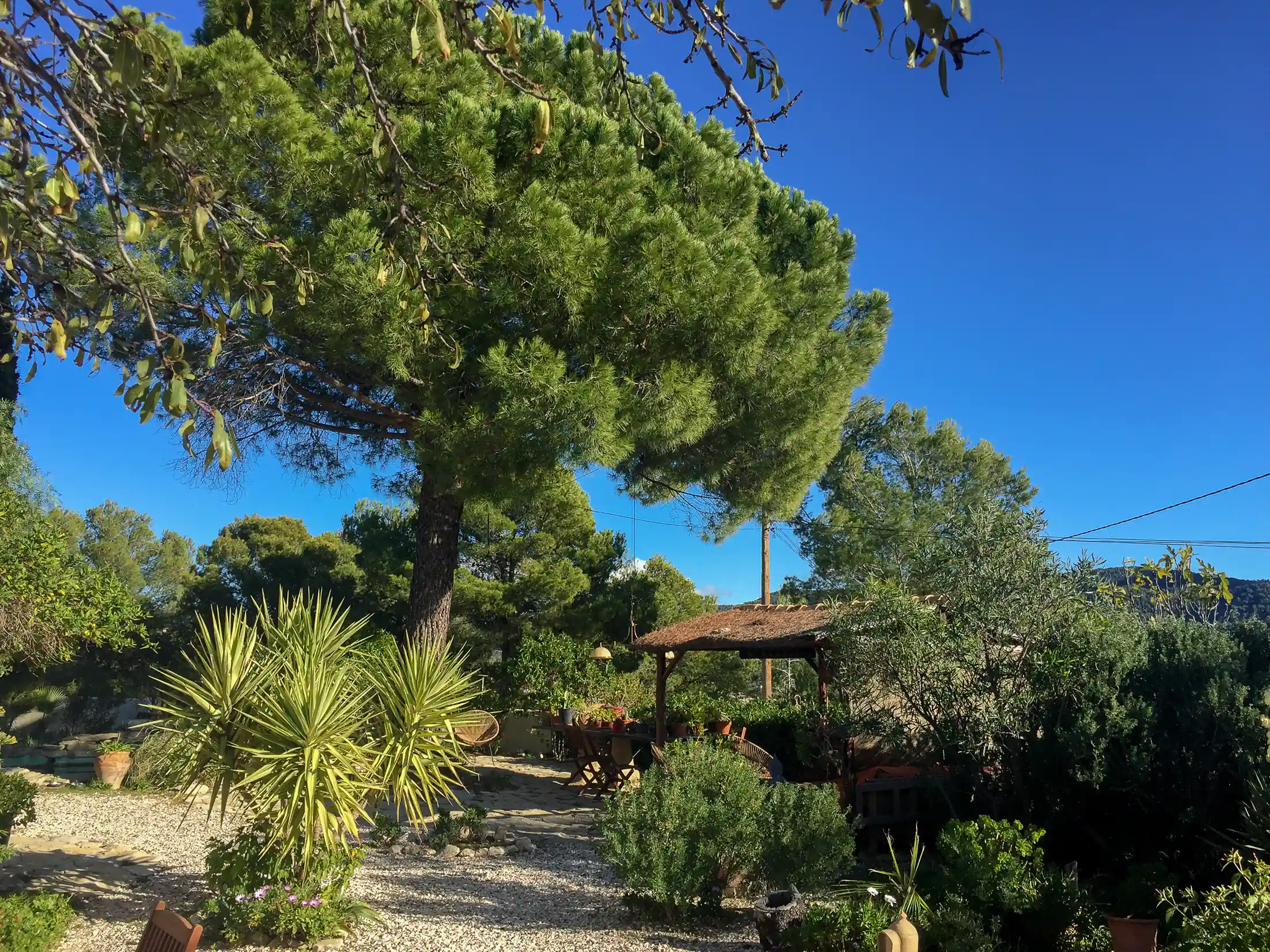
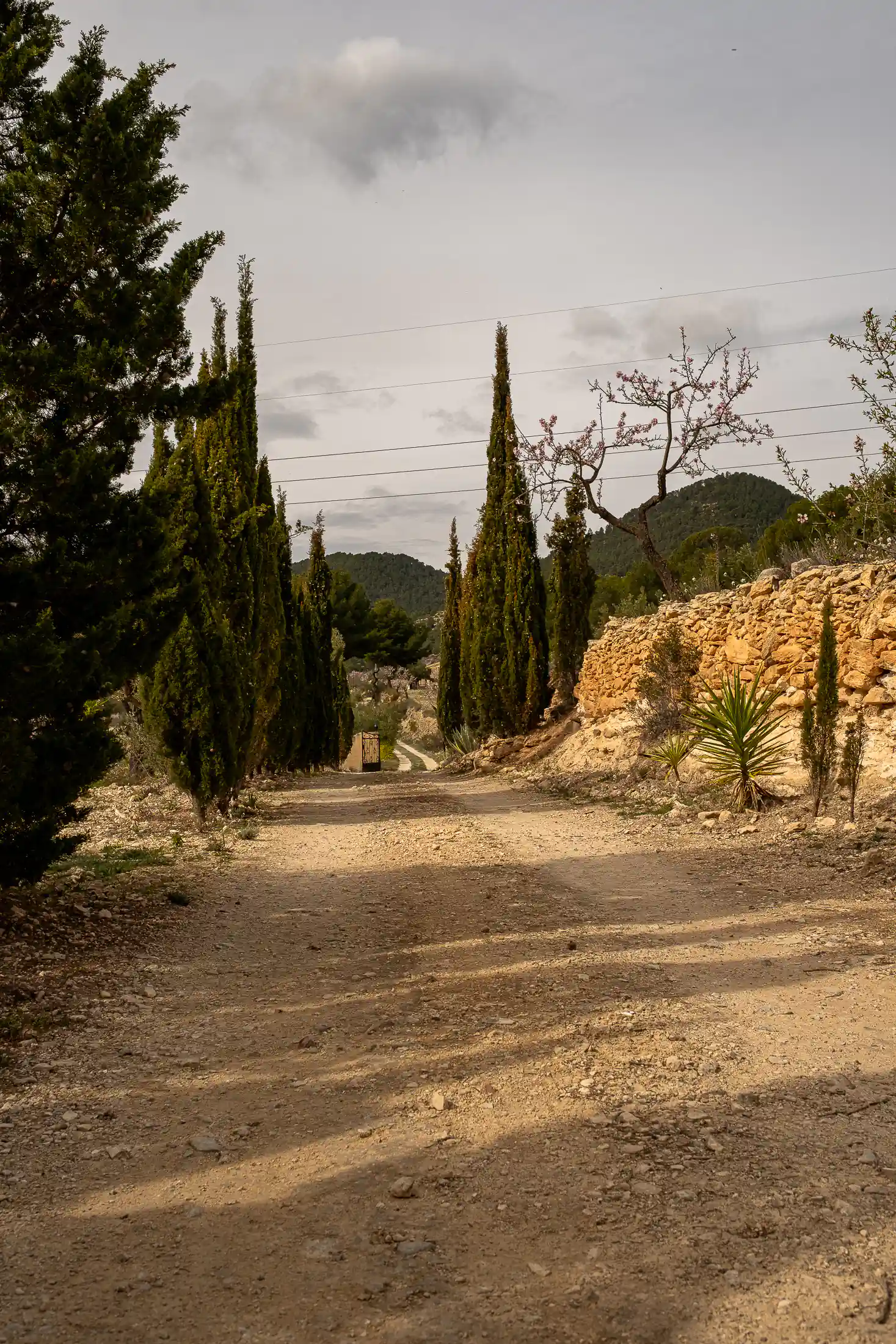


Located at nearly 800 meters above sea level in the Alicante region, the house overlooks an open landscape of terraced olive groves, almond trees, and majestic pines. Just a few kilometers from Torre de la Mançanas—a picturesque village renowned for its mild climate and preserved natural surroundings—it enjoys ideal tranquility for reflection and creation while remaining easily accessible from Alicante. Built of “Taperal,” a local stone characteristic of the region, the residence offers several outdoor spots for working, reading, or simply enjoying the calm.Its privileged location, both isolated from urban bustle and open to an exceptional panorama, makes it a refuge conducive to inspiration and relaxation.
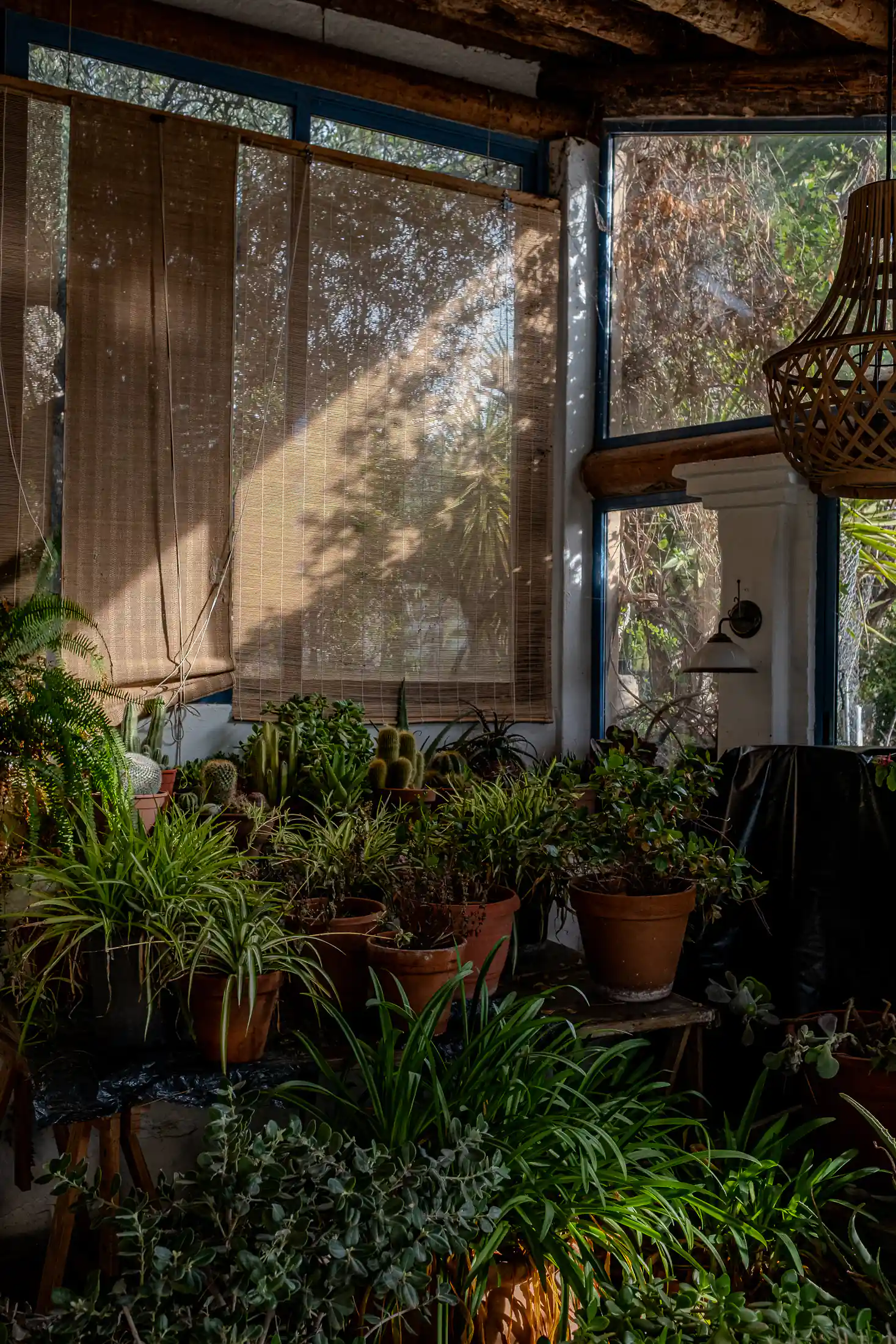
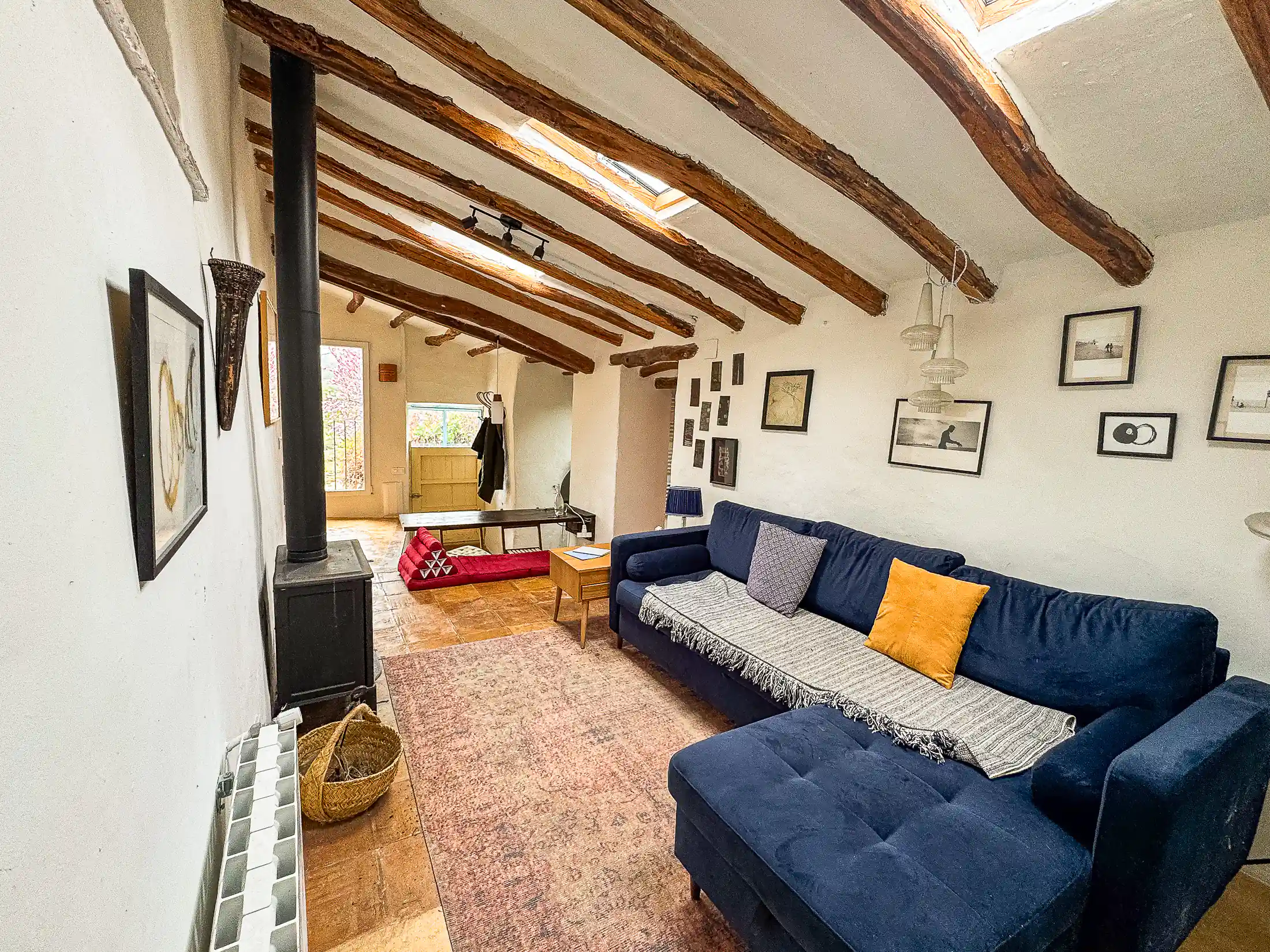
The studio dedicated to the artist residency is set up at one end of the house, with an independent entrance, while remaining connected to the main house if needed. It includes a small bedroom with a double bed, a living area with a sofa‑bed and wood stove, as well as a kitchen and a bathroom. Two “casitas,” small metal-and-glass cubes installed in the garden, can serve as comfortable bedrooms immersed in nature or be transformed into 3 × 3 m studios, thus providing additional spaces to work or relax.
In addition to the “casitas,” which allow for working in nature while enjoying the comfort of an enclosed space, a 7 m² dojo has been built at the back of the garden. Sheltered from the elements, it offers a suitable location for outdoor artistic or physical practices in a peaceful, secluded atmosphere, while maintaining a direct connection with the natural environment.




acces details
Open to all artistic disciplines, our residency welcomes you for creative projects with total freedom. However, please note that while the studio space is designed to inspire your work, it remains intimate in size. Likewise, you will not find any art supplies, heavy equipment, or machinery on site. You will therefore need to bring your own tools or devise creative solutions for any technical installations.
In line with a vision that supports and encourages artistic creation, no rent will be charged to our residents. As the heir to a house that once belonged to an artist, it embodies the spirit of sharing in the face of the economic challenges that creators face.
Nevertheless, as this is private property, a contribution of €100 per month is requested. This fee ensures the sustainability of the project and allows this unique place to continue serving as an inspiring and accessible resource for artists of today and tomorrow.
Drawing inspiration from the landscape’s transformations and climatic conditions, the residency is divided into four periods, each corresponding to a season. The panorama changes throughout the year, offering unique atmospheres conducive to creation.
The residency start dates are set on October15, January15, April15, and June1. To ensure an efficient selection process, applications must be submitted with a minimum notice of three months.
The availability of the next session is announced on this website (look a little further down).
To submit your application, please send us an email that includes a photo and a detailed presentation of your project, explaining your artistic motivations. We also invite you to attach a brief biography, your artistic CV, and a description of your artistic affinities.
This will allow us to better understand your creative universe and foster dialogue through the diversity of approaches within our residency.
MAS
DEL
TAPERAL
artists
Show up with my rolling suitcase, packed with markers, ready to draw. Crafting a tapestry so as not to blend into the background.Already gearing up for autumn, the Topor and Beccari exhibition. Taking a breath, reflecting, sketching. Putting the portfolio together, conceptualizing the publication. Working on the autumn CWB-Paris exhibition, too. A suitcase loaded with desires and ideas to bring to LIFE.And then needing to catch my breath. Breathing again.
Reconnecting with the scenery, the landscapes, the earth, the sounds, the pine needles… Finding breath back in the pine. Expecting this moment to yield time for myself. Solitude. Reclaiming solitude, extracting its essence, and using it to reboot.I want to pursue the Taurémachie video project started last year. Imagine new shots. Fabric, ink, lines. A race. Maybe an escape. A flight forward. Work with whatever is there: the breath, the raw material, the landscape, the solitude. And let the ideas come to life.
Not everyone is fortunate enough to experience a life-altering creative journey in such a magical place. For me, that magic unfolded at Mas de Taperal in Torremanzanas, where I became the first artist-in-residence. My space—a century-old Spanish farmhouse—was warm, inviting, and bathed in natural light, the perfect haven for artistic exploration. I began by painting within the garden’s embrace, my brush guided by the colors and textures of the land. Slowly, my work expanded beyond its borders, spilling into the rolling hills and winding streets of nearby towns, each crooked alley and sunlit corner offering boundless inspiration.

At the end of a full creative day, I’d walk the familiar twenty-minute goat trail into town, gathering food for dinner while plucking rosemary, sage, and thyme growing wild along the path. The rhythm of that routine, the quiet communion with nature, became part of the art itself.Returning to the States, I felt the weight of leaving that oasis behind. The transition was difficult—until my first exhibition of the works created there reminded me just how extraordinary the experience had been. At first, I hesitated to share it, guarding the memory like a rare treasure. But in time, I found myself shouting to anyone who would listen about the dream that had come true.
I Believe I Still Hear
About the residency Le Mas de Taperal in Torremanzanas, Spain
A turnkey creative refuge that supports the development of artistic workBy offering me the time and isolation I needed, the residency allowed me to better structure this project, which had been in gestation for several years. Thanks to an individual living and working space, as well as flexibility in duration, the residency provides an environment conducive to long-form creation and intimacy—standing in contrast to the demands for productivity and optimization that too often hinder artistic work.Rooted in a daily rhythm of long outdoor walks and excursions throughout the region, my research process benefited from a sensory experience centered on questions of light and space. The quietness of the surroundings and the beauty of the landscapes undoubtedly contributed to a deeper understanding of this work, in which physical and emotional interrelation plays a major role.

About the research
A photographic project about an orientalist opera, palm trees, and memory
Today I am leaving for the residency in Torremanzanas, located near Elche, home to the largest palm grove in Europe.For a month, I will be photographing palm trees, as I have been doing for several years in different parts of the world, using a Polaroid SX-70 and black-and-white instant film.This project was born from a memory—a memory of voices, music, presence.My mother loved listening to opera arias on the radio. I remember her turning up the volume whenever she recognized a familiar tune. Her eyes would shine, and she would sing along, awkwardly.One day, I heard Nadir’s Romance from The Pearl Fishers by Georges Bizet again. That aria resurrected something deeply buried within me: my mother’s voice. A voice long gone, forgotten, returning through the music.“I believe I still hear, hidden beneath the palm trees, her tender and resonant voice,” sings Nadir, in this waking dream where past and present merge.Since that day, I have been photographing palm trees—those exotic silhouettes turned familiar, those silent witnesses populating the Western colonial imagination. At first, I didn’t know why. I simply had to. This attention to palm trees, which became an obsession, was perhaps only a confirmation bias: they had always been there, but now I saw them. As one sees someone again in a reflection.These photographs are made exclusively with instant Polaroids, whose very nature evokes memory: immediate yet ephemeral, often imprecise, sensitive to time. The Polaroid, with its trembling contrasts and soft edges, behaves like a mental image.It freezes a moment while suggesting its imminent disappearance. Like memories, it reveals itself slowly, letting shapes emerge that were there but not yet seen.Each image becomes a fragment of memory—personal, but also collective.But this project extends beyond the intimate. It also questions what The Pearl Fishers represents: a key work of 19th-century musical orientalism. A French opera set in Ceylon (Sri Lanka), imagined through the exoticizing lens of colonial Europe. As is often the case in orientalist works, the “Orient” serves merely as an aesthetic pretext, a projection screen for Western fantasies.As Edward W. Said reminds us in Orientalism (1978), “Orientalism was more than an auxiliary of colonialism; it was its alibi, a mode of domination through discourse, through the performative power of representation.” Said shows how orientalism, by linking knowledge and power, helped justify European colonial expansion—by creating an imaginary Orient that naturalized domination.Even today, this opera is still performed regularly, often without questioning the gaze it casts on the “other.” But what does it mean to look at such representations in a post-colonial world? What does it mean to listen to, applaud, exhibit, or transmit these works today?From a sociological perspective, this project also draws on the analyses of Pierre Bourdieu, who wrote in Distinction (1979):“The museum matters to those who go to it insofar as it allows them to distinguish themselves from those who do not go.”Opera, like contemporary art, participates in this logic of distinction and cultural legitimation.And as Antonio Gramsci, quoted by Bourdieu, put it:“The worker tends to carry into all areas his dispositions as an executor.” This internalized symbolic domination creates a silent form of recognition of norms imposed by dominant classes.These photographs, in their fragile immediacy, are both sensitive and political objects.They tell the story of a voice rediscovered beneath the palm trees.
They interrogate a gaze, a legacy, an aesthetic of power.
They ask the question: What do we see when we look at the Orient?
And what does that gaze say about ourselves?
We spent ten days on a writing residency (working on screenplays) at Mas de Taperal. The house is magnificent, and the studio for residents offers both privacy and autonomy, making it all the more enjoyable to gather in the evening under the large tree on the terrace for a delicious meal filled with laughter and wonderful conversations with Isabelle (and other residents).Our writing sessions in the dojo—crossed by a gentle breeze that allows you to enjoy the outdoors and the view over the hills, beneath the olive and almond trees, without suffering from the heat—were interspersed with swims always supervised by Yago, the adorable four-legged lifeguard.The village is very close (a 12-minute walk), with shops, small cafés, and a Sunday market. On Friday evenings, there is a brass band rehearsal at the casa cultural; if you’re musicians, you might even join in…Mas de Taperal is an ideal place to set your thoughts down and work far from the everyday life of Brussels.

Nous avons passé dix jours de résidence d'écriture (de scénarios) au Mas de Taperal. Le mas est superbe, le studio pour les résident.e.s permet d'avoir son intimité et son autonomie pour mieux se retrouver le soir sous le grand arbre à la terrasse autour d'un délicieux repas dans la rigolade et les belles discussions avec Isabelle (et d'autres résident.e.s). Nos sessions d'écriture au dojo (traversé par un vent très doux qui permet de profiter de l'extérieur et de la vue sur les collines, sous les oliviers et les amandiers sans souffrir de la chaleur) étaient entrecoupées de baignades toujours escortées par Yago l'adorable maître nageur à quatre pattes. Le village se trouve tout près (12min à pied) il y a des commerces, des petits cafés, et un marché dominical. Le vendredi soir c'est fanfare à la casa cultural, si vous êtes musicien.ne.s peut-être que vous pourrez vous joindre...Le mas de Taperal est un endroit idéal pour déposer ses pensées et travailler loin du quotidien bruxellois.
Mas de Taperal
Get up. Walk. Observe.
To be bathed in light,
tread the thirsty, white earth.
The wind in the pines, the breath of the place. Exercise the body, sharpen the mind.
Let the ideas flow,
the impulses. T
O PLAY TO PLAY TO PLAY is TO REVEL > Ox horns appear.
Invoke Dali.
Buñuel.
SHE will be naked.
she will wear the horns.
The telephone object as an eye, as a memory. Naked among the olive trees,
the almond trees,
early in the morning,
with the horns.
Beat the ground with her feet, raise the dust from it
Will she be the beast?
The toreador?
Both?
Maybe…
some blood? maybe some milk….
Or only mud.
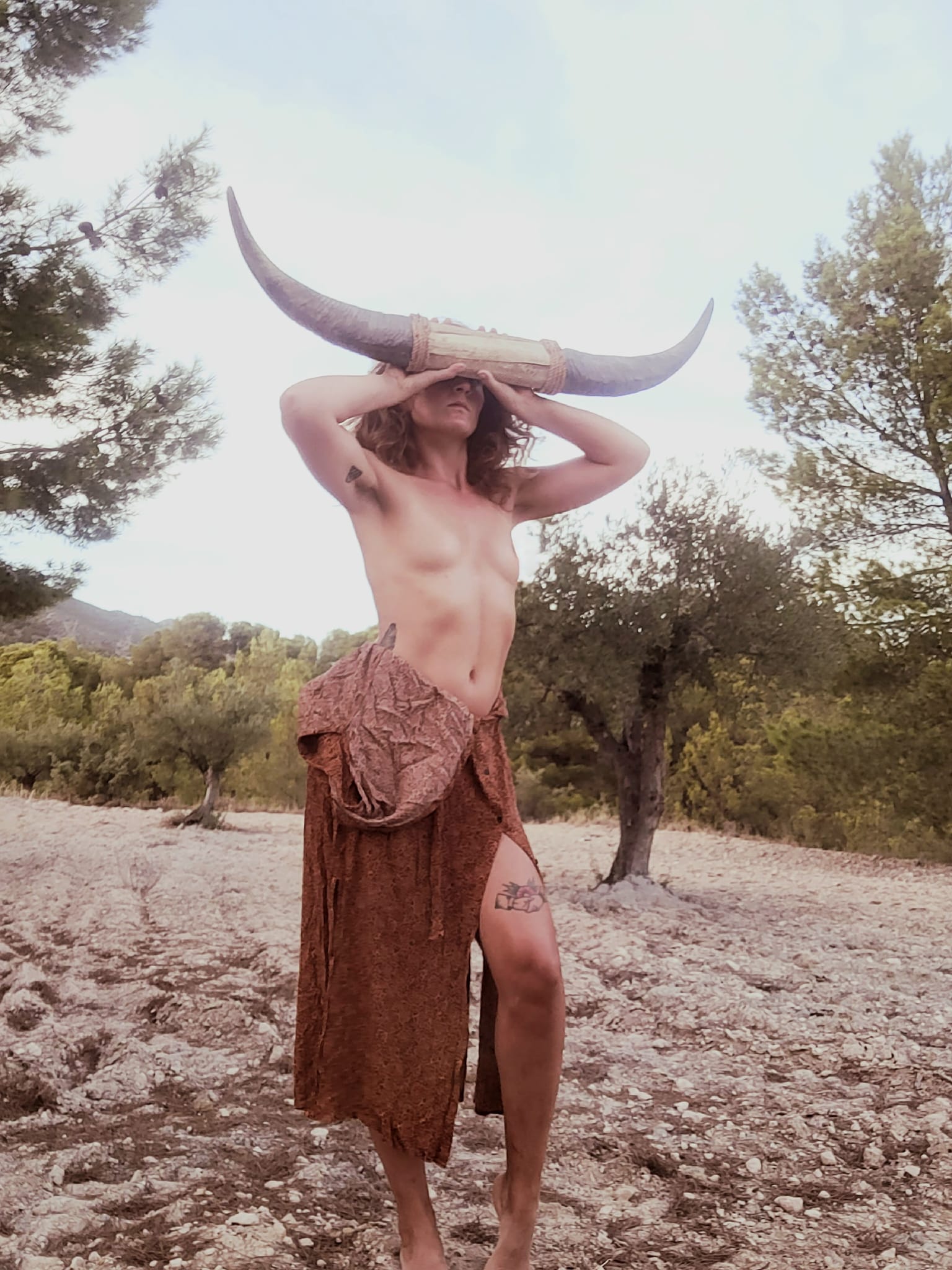
This project marks a new stage for me. I try to approach my own practice through the materials and forms I find here. They impose themselves, invite me to create, awaken my reflection on the body. Thorns, horns, earth, insects, dried flowers: each of these fragments opens up a gesture, an image for me.
A few weeks before my arrival at Mas DeTaperal, I visited Dalí’s house. I kept its imprint: the poetry of the places, the power of the objects, the strange associations that wove his universe together. I was also captivated by the summer heat: bodies stretched out, crushed, almost melted into the seats, swallowed by the burning mass. These visions still accompany me, echoing my readings and rereadings around surrealism, Dalí, Bataille and his egg. Shortly before my departure, I also welcomed the person in charge of the Daily-bul in La Louvière to my studio. A solo exhibition project is taking shape. We talked about Topor, his collection, and the way our universes could dialogue. At Mas Del Taperal, I work with what the territory offers me. I collect, I draw, I film, I perform. The bestiary (bull, insects, molts, horns) intersects with naturalistic observation (crumbly earth, pines, shadows, dry flowers). Play establishes itself at the center: playing with matter, the body, the image. Because to play is also to revel, to relentlessly search for a narrative of the lived experience, of the sensible, of being.
In my work, the body enters into a relationship with objects, elements of furniture, raw or symbolic materials. This relationship is neither purely utilitarian nor decorative. It is inscribed in a tension: that of a body seeking to inhabit or disrupt the world of fixed forms. This tension sometimes evokes, despite myself, practices from BDSM spheres, such as forniphilia — this term, whispered by Tristan Trémeau a few days before my arrival here, designates the practice where the body becomes furniture, where the furniture becomes a partner. But where this practice stages domination and submission, I divert this dynamic towards a poetic, ritual and political research. The furniture then becomes a symbolic fulcrum: load, totem, extension of the body, or even a body in itself. I am not looking to “become furniture”, but to shake up the hierarchies between human and object, animate and inert.

I slip into this ambiguous zone where the body ceases to be a sovereign subject to become matter among matters, a territory of inscription, of transformation, of fiction.
What interests me is not the performance for its own sake, but the way the body can embody an idea, a conflict, a desire, a memory. The furniture becomes a trace, an interface, a play partner. It opens up this question: what is a free body in a world saturated with standardized forms and rigid roles? Thus, I seek tipping points. The body is never neutral. I stand in this in-between — between gesture and obsession, drive and object. Where forniphilia codifies power dynamics, I attempt to open a space of play and disruption. I invoke the surrealist and feminist legacy of figures like Dalí's Drawer-Women or Louise Bourgeois's House-Women (Femmes-Maison): bodies turned into containers, architecture, the extension of a mental space.
Bataille's thought circulates beneath the surface: the taste for transgression, eroticism as knowledge, the blurring of the sacred and the material, of the sublime and the abject.What I seek is not to shock. Nor to seduce. But to open a rift. A breach where the body — traversed, constrained, glorious, or minuscule — becomes both word and image.
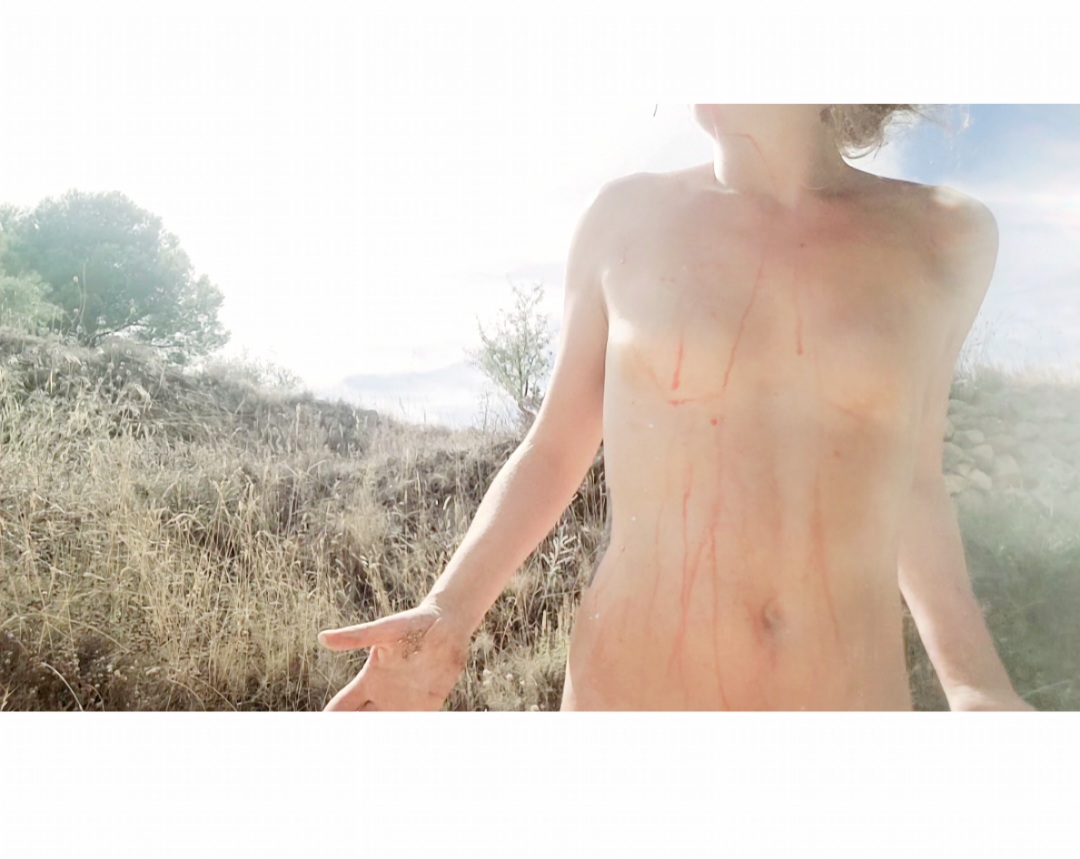
My work progresses like a series of rebuses: drawings, videos, performances. Together, they attempt to compose a poetic memory of the place, between presence and erasure, care and wound, the real and the imaginary.
A passage by Vinciane Despret resonates particularly with my way of working:"... the works themselves were going to produce these links, I had to let them connect with each other, trusting in their power of articulation and friction. I had to let myself be worked on and instructed. I myself became the subject of the experimentation: making myself available to what the pieces would create among themselves—links, questions, complicities, new beings, answers that I had to learn to welcome. I finally found the way to break away from explanations."
(V. Despret, Récits de ceux qui restent, p. 38)
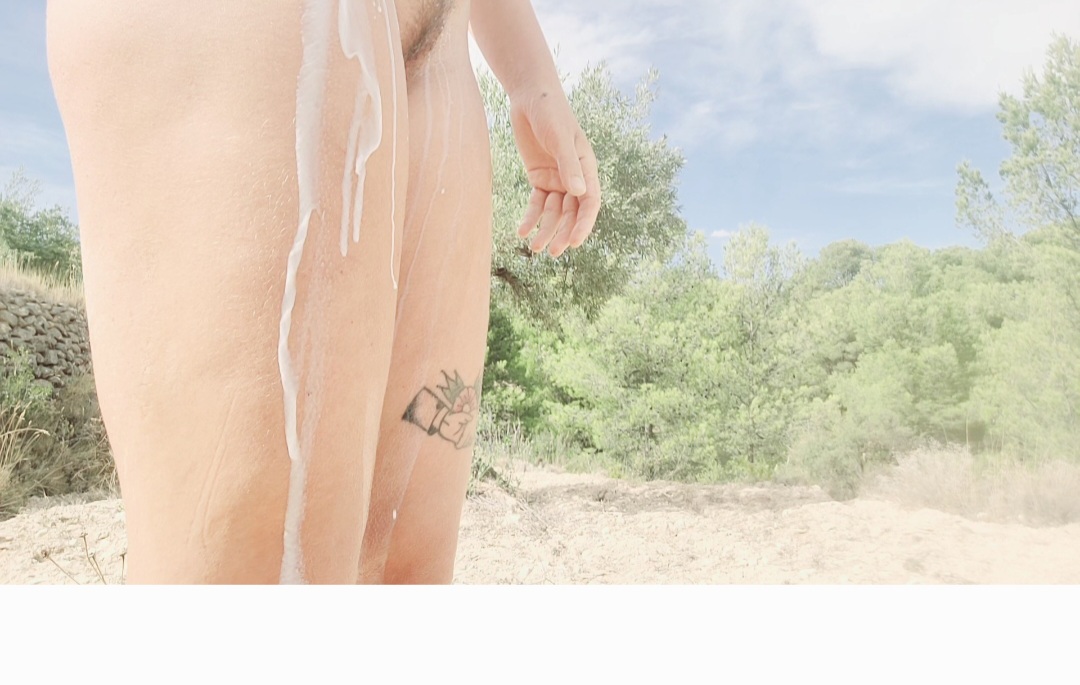
Today, Monday the 8th, I realize I only have four days left here. A sweet nostalgia washes over me: that of still having so much to do. I have learned here to slow down, to let time settle. The tranquility of the place has infiltrated my practice. This is undoubtedly the true lesson of this residency.I would like to come back to film, with a camera and a tripod that I will have delivered or slip into a larger suitcase. I will also buy a new computer: my old machine can no longer keep up, and for video editing, that matters. But I will return, because sometimes you have to accept that the work takes its time.I had never drawn like this before. It surprises me. I now integrate an imprint of this earth into my drawings. I paint with the ochre dust, trace the silhouette of these fascinating trees, assemble the thorns into crowns, into nests. I intersect what comes from me with what is offered to me.The video may not look like the one glimpsed in a dream — but it doesn't matter. It already exists, somewhere. It will exist again, with the right tools, perhaps also with an accomplice-presence by my side to film. To capture?
Yesterday, it was Deleuze who invited himself in, with his "becoming-animal". I liked the images he deployed. I retain a simple idea from it: stepping out of a closed identity to emancipate oneself. For there is no territory without a line of flight.
Each reference acts as a thread in the weaving of my research, a voice that accompanies and diverts my own obsessions.
Bataille (the eye, eroticism, transgression, abject matter) → a body as excess, the flow of milk and blood as a sacred vision.
Dalí (the egg, the double, mutation, furniture-women) → transformation of reality into a mental image, the body as metaphor.
Topor → grotesque, absurd, displaced eroticism, visual obsession.
Jodorowsky → initiatory rite, archaic symbols, ritual sexuality, milk/blood.
Arrabal → theater of cruelty, female nudity, poetic and political language.
Lynch → dissociation of reality, sensory shifts, vanished bodies.
These influences do not form a fixed pantheon, but a fertile ground of associations, a torrent of images from which I draw to build my own fragments.
At Isabelle's we speak
French
English
But also dog
We sniff
We stick out our tongues
We swim
We shake ourselves off
We yawn
We vocalize
We lick our lips
We work
We sow
We love each other
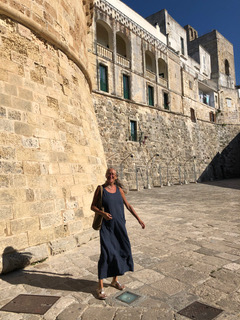
in the headlights
the Mas
welcome
kindness of stones and time
stillness
discreet presence
& yago running wild !
sharing
rhythm of the wind
pine forest or almond grove?
looking outside
pink and white explosion
opening the world
forgetting it
breathing
letting come
writing
From painting to photography, from photography to video, from video to installation, from installation to environment, from environment to scenography, from scenography to theater… and always, telling a story, giving shape to disorder, from the depths of inwardness.

A residency... I am not accustomed to this. There was an idea: to produce a chapter of a book. A book in limbo, on hold,for far too long. And to lift an obstacle, to untie this stubborn knot. Books, documents, the dream of a discipline, of availability. But I am weighed down, cluttered. And then there is Spain, that language calling to me beyond my duties.And the mountain—green, flowered, white. So, to walk. A quadruped calls me there. Jovial, enthusiastic. Jago. Guesses the paths, scents them, knows them.
And while walking, other clarities reveal themselves. From them emerges a manifesto, for the days and years to come.
And the bond with the host, the attentiveness, the spoken word. For the years to come. The book is at the end of it, still caught in its knots. But unsuspected clarities have invited themselves in, like an understanding, a confirmation.
I will return. One must walk.
MAS DEL TAPERAL
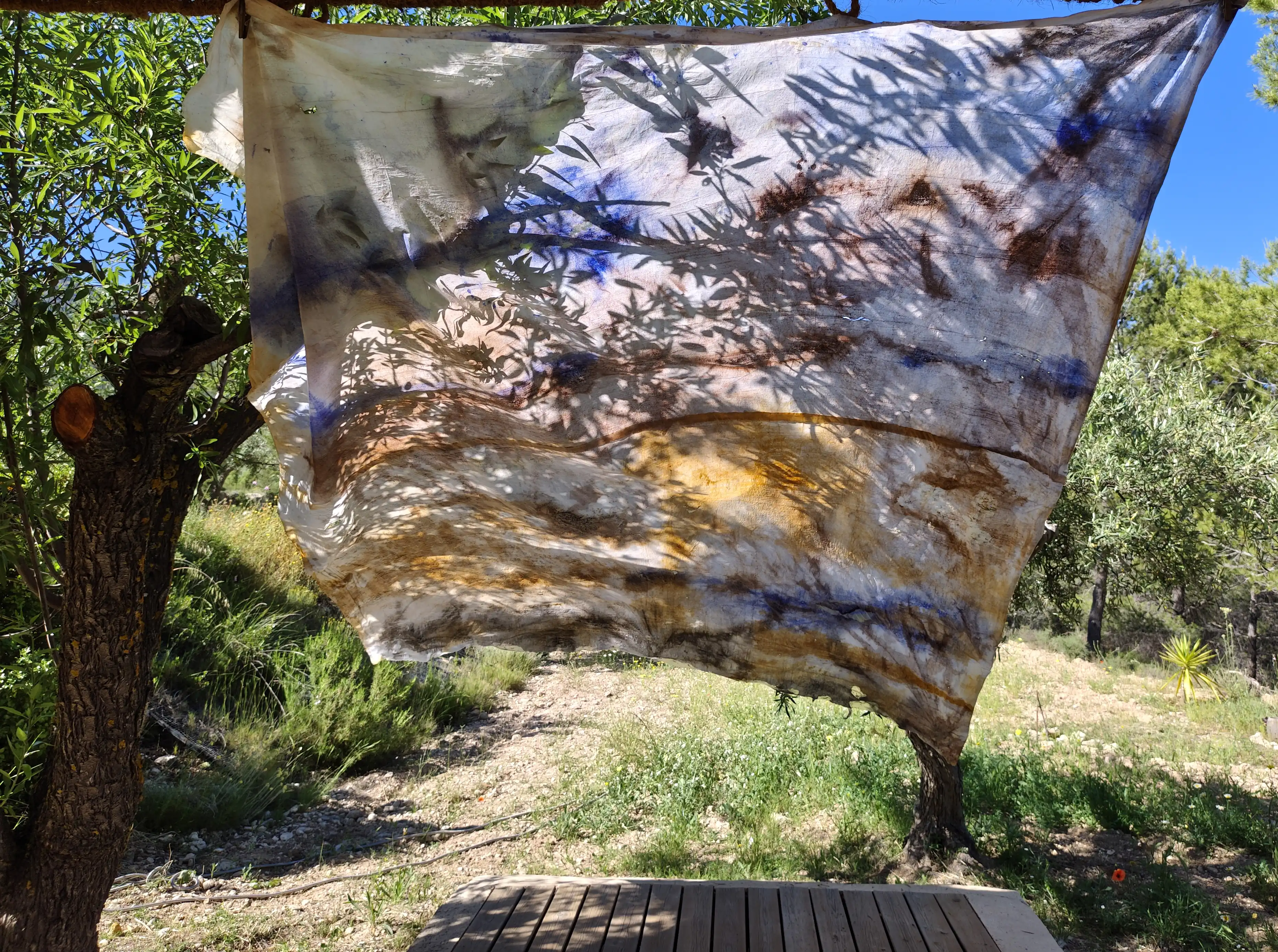
SPACE Working outdoors, where the search for shade forces constant movement—a fluctuation that has become a core axis of the work.
WATER Water mixed with pigments flows into the hollows; the pigment molds to the contours of the earth. The paper takes an imprint of the ground, tracing the earth's surface.
WIND Papers left on the ground overnight are altered by moisture or animals. These papers were installed differently: laid flat on the ground and suspended in space.LIGHT The suspended papers, along with the intervention of the wind and shadows, give them movement. How can these large sheets of paper structure and deconstruct space? And how can they interact with natural elements? How can these natural elements be transfigured within an enclosed space?
EARTH AND STONES Gleaning stones and other materials. Collecting elements found on-site, arranging or transforming them, juxtaposing them with paper or other mediums to open up poetic perspectives.
TO BE CONTINUED Exploring the territory and its distinctiveness, tracing the relief of the ground, sampling plots of land based on my movements (tracing rocks, concrete, and construction structures). Installing the papers or fabrics to deconstruct the space and destabilize perception. These collections of traced marks exist not only to record territories or fragments of architecture, but also to reveal their fragility, their movement, and their transformation..
.webp)
If the fixed you know how to dissolve,
And the dissolved make fly away,
Then the flying fix into powder,
You have reason to be consoled.
Alchemical Treatise
.webp)
MAS
DEL
TAPERAL
contact
Questions? Would you like to apply? Or something else?
write to us